

Most of us do not have a desire problem.
We care about our families. We want to lead well. We want our churches, teams, businesses, and relationships to become healthier. We genuinely want to be faithful with what God has placed in our hands.
But let’s be honest: caring deeply does not automatically mean we are living intentionally.
We can mean well and still repeat the same patterns. We can work hard and still avoid the decisions that matter. We can stay busy while the distance grows between what we say matters and what our choices are actually producing.
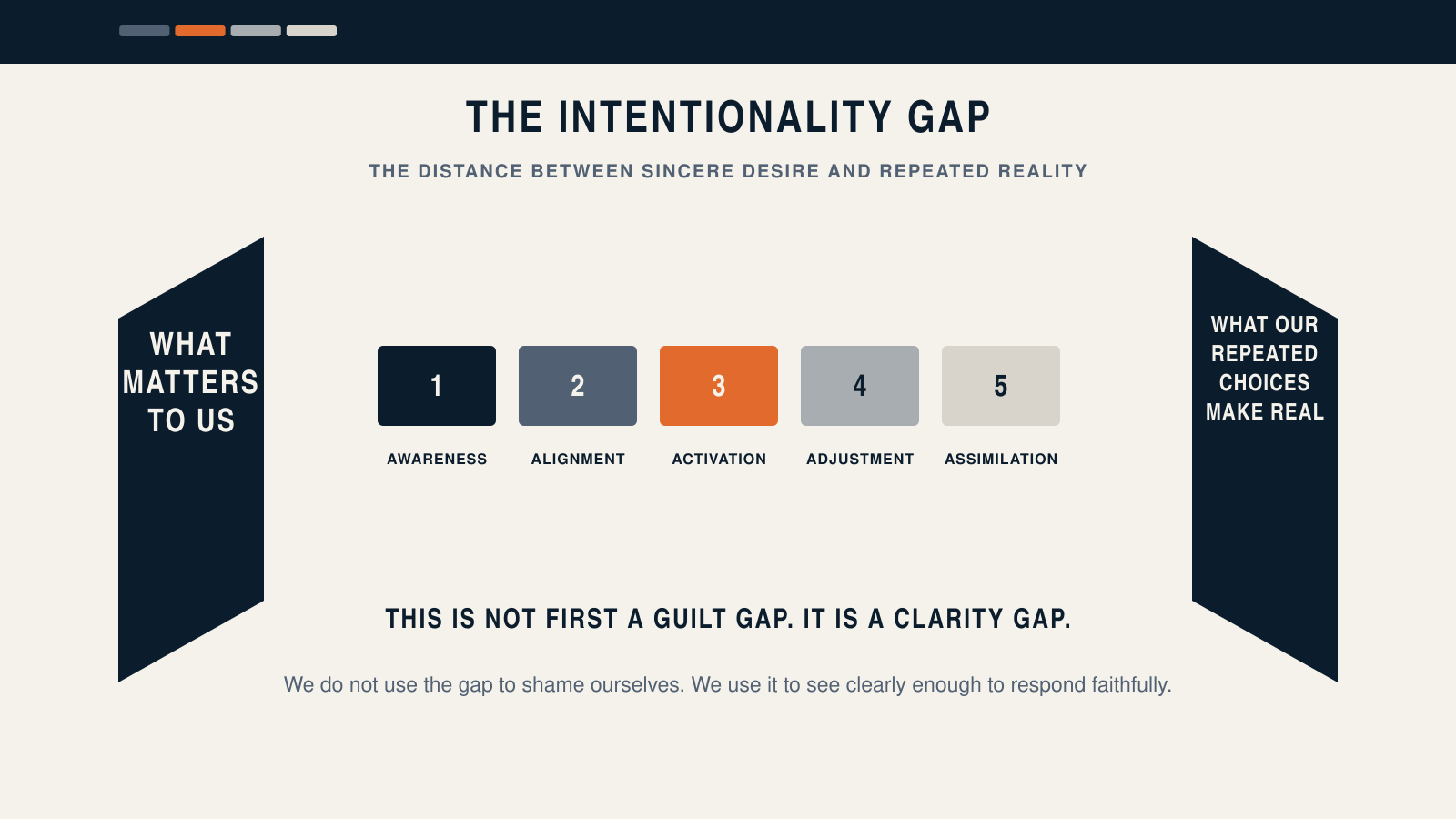
That distance is what I call the Intentionality Gap.
Intentionality is the disciplined process of closing the gap between what matters to us and what our repeated choices make real.
This is not first a guilt gap. It is a clarity gap.
We do not look at it to shame ourselves. We look at it because we cannot faithfully lead what we refuse to see.
Romans 12 Is a Picture of Intentional Living
Romans 12 begins with surrender and transformed thinking. It moves into honest self-evaluation, grace-given gifts, diligent leadership, genuine love, patience, generosity, hospitality, humility, and peace.
It is not merely a chapter about discovering what we have been given.
It is a chapter about becoming responsible for what grace has placed in our hands.
Paul writes:
“If God has given you leadership ability, take the responsibility seriously.” — Romans 12:8 NLT
That line carries weight because it joins grace and responsibility.
Grace gave you something. Intentionality is how you take responsibility for it.
This is not pressure to prove ourselves. It is not frantic activity, perfectionism, or leadership built around control. It is diligent stewardship. It is allowing transformed thinking to become a recognizable way of living.
Good Intentions Need a Path
The Illusion of Intentionality is the assumption that because I care, mean well, work hard, or genuinely desire an outcome, I am already being intentional.
The desire may be completely sincere.
But desire is not execution.
The issue is not whether the desire is real. The issue is whether the desire has been given a design.
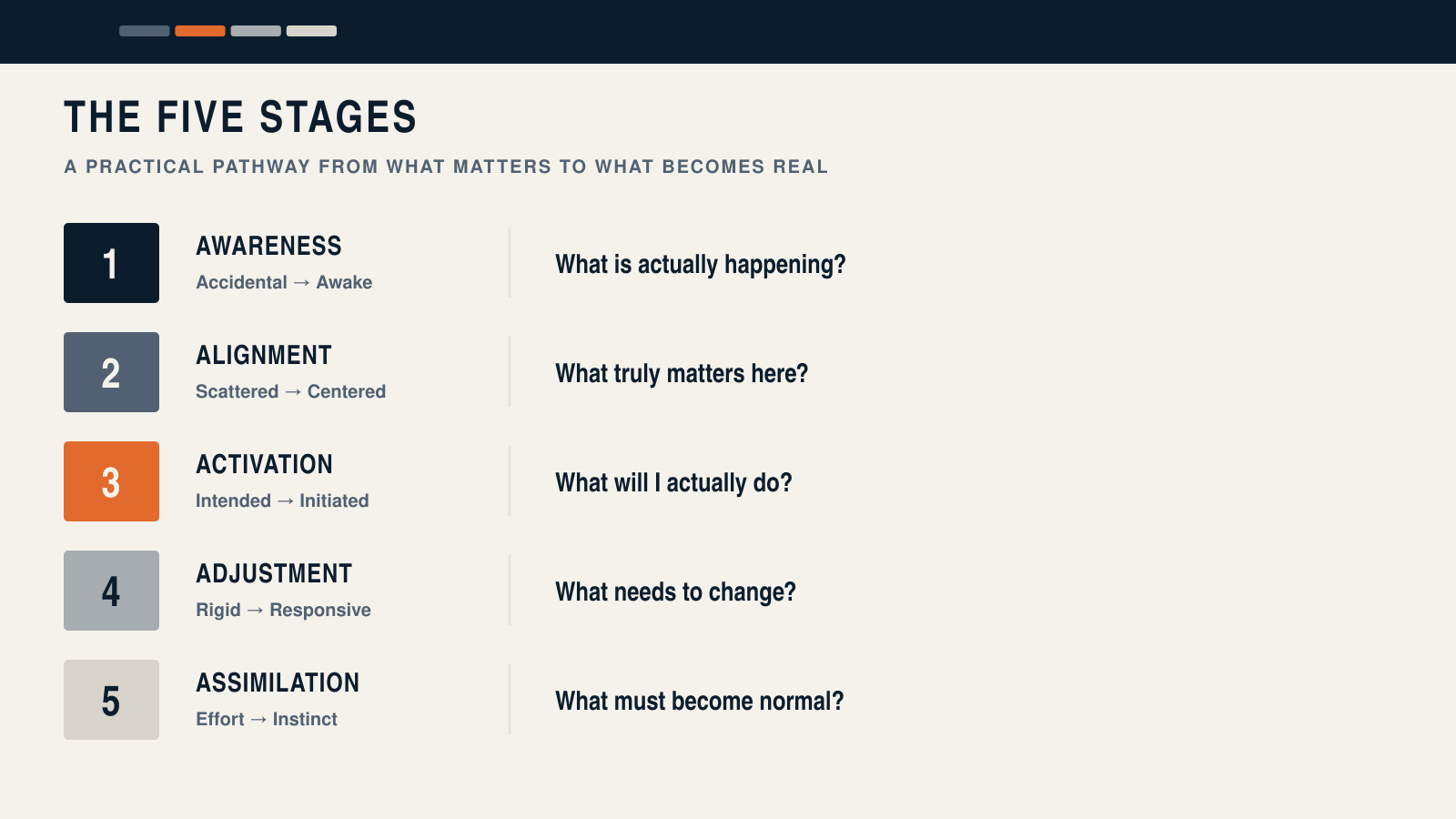
The five stages provide that design. They are not five personality types or five labels to wear. They are a practical pathway that helps us move from assumption to awareness, from intention to action, and from effort to a new normal.
Stage 1: Awareness — Accidental to Awake
The question: What is actually happening?
Intentionality begins with honesty.
Before we can lead what God has placed in our hands, we must become honest about how we are currently carrying it. That means looking beyond what we intended and examining what our repeated choices are producing.
Awareness asks us to look in four places:
- Results: What is repeatedly being produced?
- Rhythms: What habits, systems, or repeated choices are producing those results?
- Relationships: What are the people closest to this actually experiencing?
- Resistance: What have I been avoiding, defending, explaining away, or blaming on circumstances?
Explanation may help us understand the gap. It cannot become our permission to keep it.
Awareness is not shame. It is not inflated confidence or false humility. It is seeing reality clearly enough to respond faithfully.
Intention describes what I meant. Impact reveals what it became.
Stage 2: Alignment — Scattered to Centered
The question: What truly matters here?
Once we see reality, we have to decide what will govern what happens next.
Alignment is not simply choosing what we want most. For a Christian leader, intentionality is not self-determination. It is surrendered stewardship.
We bring our thinking, priorities, gifts, calendars, and actions into agreement with what God values.
Alignment requires three decisions:
- Name the value. What conviction must govern this area?
- Define the evidence. If that value were genuinely governing my choices, what would become observable?
- Identify the competition. What keeps displacing what matters—urgency, approval, comfort, fear, control, habit, opportunity, or fatigue?
If everything matters equally, pressure will decide what matters today.
A value that never changes a decision is still only a preference.
Stage 3: Activation — Intended to Initiated
The question: What will I actually do?
Activation is where conviction becomes behavior.
It translates what matters into a specific action, rhythm, decision, boundary, habit, or system. It gives the intention a time, a place, and a next step.
This is where many sincere intentions stall. We make the action so large that it depends upon unusual motivation. We overvalue intensity and undervalue repeatability.
A strong first action should be:
- Clear enough to describe
- Small enough to repeat
- Meaningful enough to matter
- Attached to a real time or trigger
- Observable by someone other than us
- Given room by stopping or reducing something else
Grace gives the gift. Diligence puts the gift to work.
Inspiration names what could change. Activation decides what will happen next.
Stage 4: Adjustment — Rigid to Responsive
The question: What needs to change?
Once action begins, reality provides feedback.
Some people protect the original plan even when it is no longer serving the intention. That is rigidity.
Others abandon the intention as soon as the plan becomes difficult or uncomfortable. That is reactivity.
Adjustment does neither.
It remains faithful to the intention while becoming teachable about the method. It asks what worked, what did not, what reality taught us, what must remain, and what should change.
Faithfulness to the intention does not require loyalty to a failed method.
Humility keeps diligence teachable.
Adjust the method before you abandon the mission.
Stage 5: Assimilation — Effort to Instinct
The question: What must become normal?
Assimilation occurs when the desired behavior no longer depends entirely upon inspiration, constant reminders, or one leader’s personal energy.
Personally, it begins to look like instinct.
In a family, it becomes rhythm.
In an organization or church, it becomes atmosphere or culture.
You know assimilation is taking root when the language is shared, the rhythm is expected, the value is reinforced, and the practice can be carried by people other than the person who started it.
Culture is what continues when the person who started it is absent.
The highest expression of intentional leadership is not personal control. It is shared conviction.
Intentionality Is a Cycle, Not a Staircase
The five stages describe a progression, but they are not a staircase we climb only once.
Awareness reveals reality.
Alignment clarifies what matters.
Activation turns conviction into action.
Adjustment learns from reality.
Assimilation establishes a new normal.
Then we return to Awareness.
That return matters because even a once-intentional practice can become unexamined autopilot.
Autopilot is often yesterday’s intentionality left unexamined.
Start With One Area
You do not need to fix everything today.
Choose one meaningful area of your personal life, spiritual life, family, leadership, team, organization, ministry, or church. Then answer five questions honestly:
- Awareness: What is actually happening?
- Alignment: What truly matters here?
- Activation: What will I actually do?
- Adjustment: What needs to change?
- Assimilation: What must become normal?
Do not begin with a promise to transform your whole life.
Become awake to one thing.
Center it on what God values.
Initiate one clear action.
Remain humble enough to adjust it.
Repeat it faithfully until it becomes part of who you are and how you lead.
Take the Framework With You
I have created a full participant handbook to help you work through the Intentionality Gap, apply all five stages, design your first action, establish a review rhythm, and describe the new normal you are building toward.
What matters deserves more than a good intention.
It deserves an intentional life.
— Dr. Craig Smee
0 Comments